
Green Clinic field note
Why do pine hawk moth Sphinx pinastri threaten conifers?
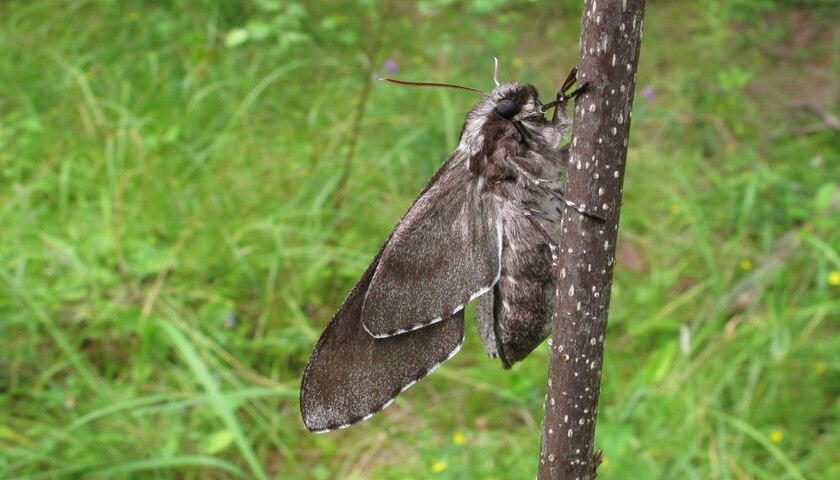
The pine hawk moth, Lat: Sphinx pinastri, is a butterfly of the hawk family that is a pest of pine forests of the European continent, Asia, North Africa and North America. In recent years, this moth is increasingly settled in pine forests of Ukraine.
The pest insect feeds on needles, so its activity can cause significant loss of coniferous plants, particularly pines. The butterfly eats needles and the bark of pine trees.
In this article we will tell more about the peculiarities of the biology and distribution of the Pine hawk moth, as well as consider the symptoms of damage to coniferous plants and methods of controlling this dangerous pest.
Biology and distribution of the pine hawk moth
The pine hawk moth is a nocturnal butterfly, so its activity increases with the onset of dusk, being particularly active from late spring to late summer. The forewings are dark gray in color, which is complemented by two pale spots and thin stripes running along the hindwing.
Females lay eggs in the form of a necklace, their number can reach from 4 to 8 pieces. These eggs are laid on the needles of pine trees, it is rather difficult to notice them on the branches of the tree, because they have a greenish colour, the shape of the eggs is oval, and depressions. Eggs hatch in 20 days.
Pine hawk moth. Photo from © poknok.art
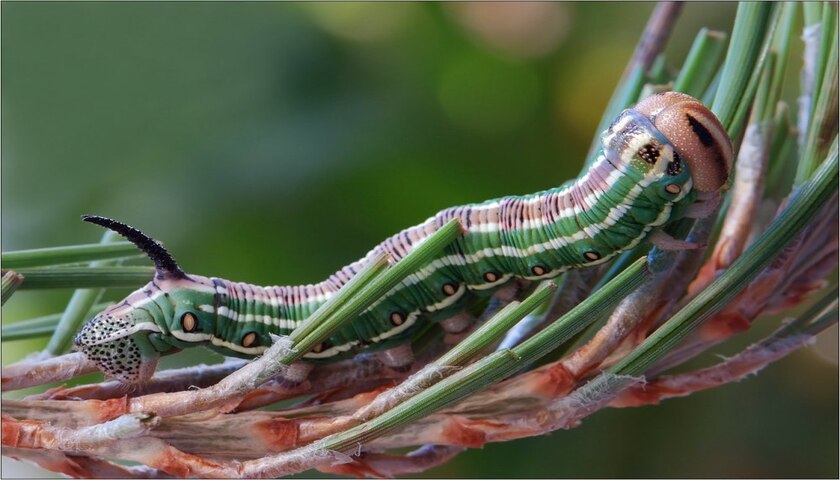
The caterpillar is green-yellow in colour with white stripes. It predominantly eats pine needles, but may threaten other conifers. At the end of June, the caterpillar leaves the tree on which it was feeding and pupates in the litter, fallen leaves or soil near the tree, there it stays until the spring of the next year. In Ukraine it settles wherever pine forests grow.
The pine hawk moth can cause damage not only to pine trees, but also to linden and fir.
If a pine tree is damaged by the pine hawk moth, the plant becomes weakened, loses its beauty, eventually dries out and dies, so it is important to carry out all necessary preventive measures in time to maintain the productivity of the pine tree for the next years or even decades.
The caterpillar is green-yellow in colour with white stripes. It predominantly eats pine needles, but may threaten other conifers. At the end of June, the caterpillar leaves the tree on which it was feeding and pupates in the litter, fallen leaves or soil near the tree, there it stays until the spring of the next year. In Ukraine it settles wherever pine forests grow.
Caterpillar of the pine hawk moth
Symptoms of pine hawk moth damage
development, from saplings to adult trees. It is quite difficult to notice the first symptoms of the disease on the surface of the tree, but over time it becomes more noticeable. These symptoms include:
– Change in the colour of needles from green to yellow, brown or red. This indicates a disruption of photosynthesis and interruption of the flow of water and nutrients from the roots to the crown.
– Falling needles from the tree. The needles can fall either as individual needles or in clusters. Falling needles start from the lower branches and gradually move upwards
– Cracks, wounds, resinous discharge on the bark or trunk of the pine tree. This indicates damage to the wood by caterpillars, fungi or beetles. Resin leaks from cracks on the surface of the trunk as a defence reaction of the tree, but this reaction is not always effective. Resinous secretions can be clear, yellow, brown or black. The resin usually flows out of cracks, wounds.
– Bending, twisting or distortion of shoots, branches of pine trees. This gives reason to talk about the violation of growth, development of the tree under the influence of caterpillars.
– The appearance of blisters, water blisters or growths on the needles.
In conclusion, we would like to add that one of the effective ways to combat the pine hawk moth is to attract insect-eating birds or to collect and remove pupae and caterpillars of this moth.
In any case, the first step towards the health of your conifers depends only on you!
Specialists of the Centre of Ecosystem Phytopathology “Green Clinic” will reveal the secret of health, beauty and longevity of plants because we care about sustainable development of society, preservation of natural ecosystems for future generations.
Our mission is to support a qualitatively new way of life in harmony between man and the environment around us.
Want more useful advice, looking for modern, innovative solutions, then
Please call +380632851405