

Since 2008 the Zelena Klinika Ecosystem Phytopathology Center has examined and treated pines on private plots, in residential communities and on company grounds in Kyiv and the Kyiv region. First we find out why the pine is ill, and only then do we propose works.
We examine every pine and the plot on site.
We write the opinion: the state of the trees, the causes of decline, a map of measures.
The works and their timing are set out in the opinion; a cost estimate is prepared on request.
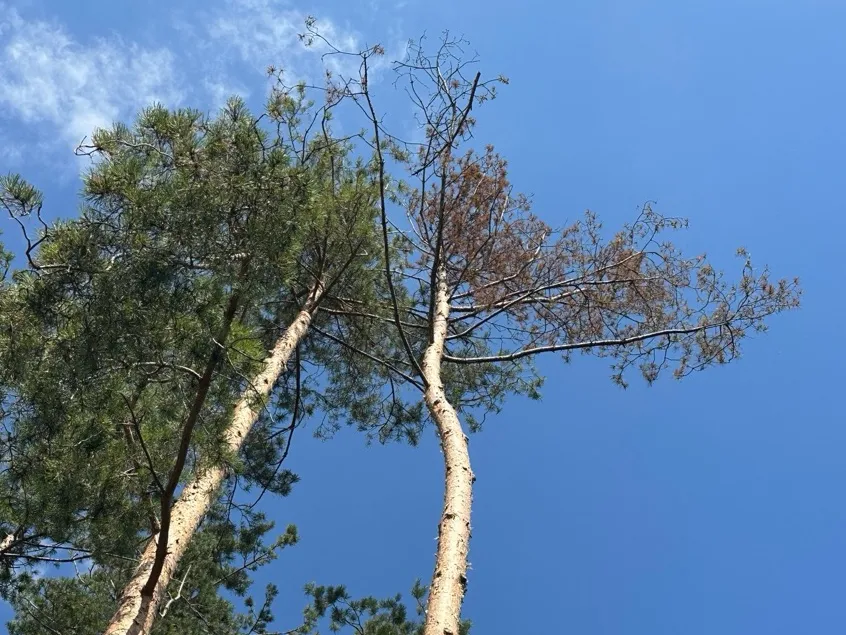
When a pine needs an examination
- Needles turn yellow or brown, or fall in spring or summer: in patches or on whole branches.
- The top or single branches are dying back.
- Small holes, boring dust or resin streaks have appeared on the bark.
- Young shoots bend or die.
- The pine weakened after construction, new paths, added soil or a dry summer.
- One or several pines nearby have already died.
Pine diseases and pests
Why do pines die back? Most often there are several causes, and they strengthen one another.
- Drought and heat. A pine short of water weakens and becomes vulnerable to stem pests.
- Bark beetles. They colonise weakened trees first. The sharp-dentated bark beetle (Ips acuminatus) starts in the upper trunk and thin-barked branches; the six-toothed bark beetle (Ips sexdentatus) starts in the lower trunk with thick bark. Pine shoot beetles also occur on declining pines. The beetles carry blue-stain fungi into the wood. More: bark beetle on pines.
- Needle and shoot diseases: needle cast (Schütte), Dothistroma needle blight (red-brown bands on needles), Diplodia blight, and on young pines pine twisting rust.
- Root rots, including Heterobasidion root rot: affected pines die in groups. Trees weakened by rot are colonised by stem pests more often.
- Sucking pests: pine adelgid, scale insects, aphids.
- Root damage and soil compaction during construction, when soil is added over the roots or a layer of it is cut away. The effects may show only several years later.
Different problems look alike, and causes often act together. That is why the cause has to be established first.
In autumn a pine naturally sheds its older needles: they turn yellow in the inner crown and fall. This is not a disease.
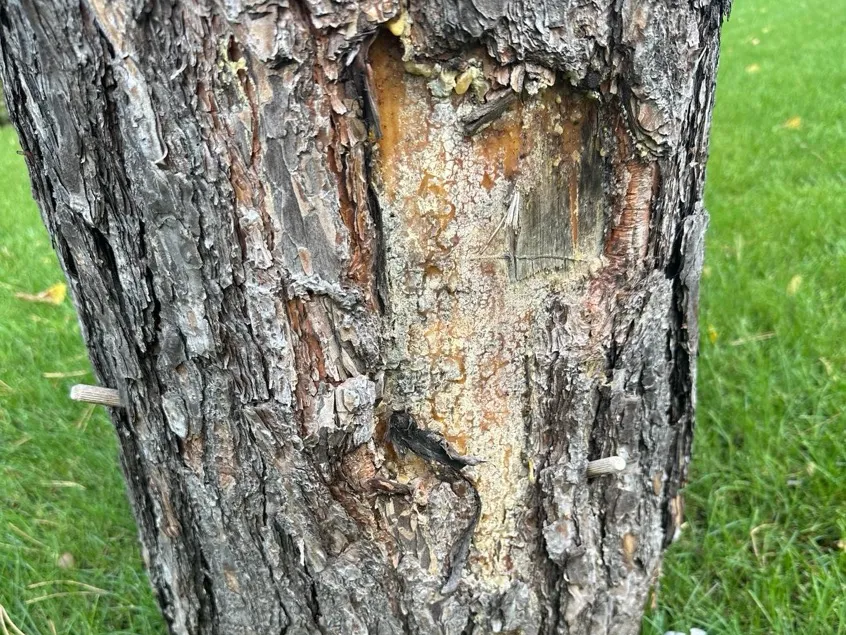
What we examine
- The crown, needles, shoots and trunk of every pine.
- Traces of pests and signs of fungal diseases.
- The root collar, soil, watering and drainage.
- Neighbouring trees and what has changed on the plot in recent years.
- Where needed, we check the trunk for internal decay: sonic tomography.
What you receive
A written consultative opinion. It describes the state of every tree and the causes of decline. Then comes the list of works in order of priority and the dates when it makes sense to carry them out. A cost estimate for works is prepared on request.
Frequently asked questions
My pine is drying and dying: what should I do?
Do not rush into treatments: the cause has to be established first. Common causes and what you can check yourself are described in the article Pine Decline After Site Changes: 7 Causes to Check.
Can a pine colonised by bark beetles be saved?
If bark beetles have colonised the trunk, the tree usually cannot be saved. It becomes a source of beetles for neighbouring pines, so the main measure is to remove the colonised tree before the new generation of beetles flies out, and not to stack colonised wood near living pines. If only the top or single branches are dying, do not wait: the sharp-dentated bark beetle starts exactly there and moves lower. What is happening to your tree is shown by the examination.
My pine turned yellow in autumn. Is it a disease?
Not necessarily. In autumn pines shed old needles, and the inner crown turns yellow. It is a warning sign when needles turn yellow or brown in spring or summer, the top dies back, or holes or boring dust appear on the bark.
When is the best time for an examination?
As soon as you notice changes. The earlier the tree is examined, the more options remain.
Can I send a photo?
Yes. A photo helps to describe the problem and agree the examination. We do not diagnose from a photo: the cause is established by the examination, on the plot or remote.
Where do you work?
In Kyiv, the Kyiv region and across Ukraine. The examination is on the plot or remote.