

Bark beetle in your pines: red needles, a dying top, holes and resin on the bark, pines on the plot or in the forest dying one after another, and you want a pine bark beetle treatment that works? You will know which pines are colonised and which can still be protected: we examine the trees and the plot, issue a written consultative opinion within 72 hours after the examination, and carry out the measures and treatment ourselves.
You can rely on the decision: a quality system with a double check of every decision. Since 2008, more than 5,000 clients.
When an examination is needed
- Needles turn pale, yellow, then red and brown: at the top, on single branches or across the crown.
- The top of the pine is dying.
- Small round holes or resin drops show on the bark.
- Rusty boring dust lies at the trunk base and in crevices.
- Fallen fresh shoots lie under the pine, holed at the break.
- A nearby pine has died: beetles move from tree to tree.

Why bark beetles colonise a pine
- Drought and heat. A pine short of water weakens and resists beetles less well; heat speeds up their development.
- The sharp-dentated bark beetle (*Ips acuminatus*). It colonises the upper trunk and thin-barked branches, so dieback often starts at the top. Outbreaks are recorded in Ukraine too.
- The six-toothed bark beetle (*Ips sexdentatus*). It colonises the lower trunk, where the bark is thick.
- Pine shoot beetles (*Tomicus*). They breed under the bark of weakened and freshly felled trees; young beetles bore into living shoots, which then fall.
- Ophiostomatoid fungi (blue stain). Beetles carry them in; the fungi spread in the phloem and sapwood and disrupt the water supply.
- Changes on the plot and wood left lying. Transplanting, root damage or a storm weaken the pine; tops, branches and fresh wood with bark become breeding sites.
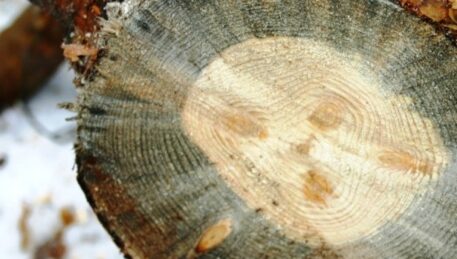
What we examine
- Every pine: crown, top, needles, shoots and trunk, to tell colonised trees from those still worth protecting.
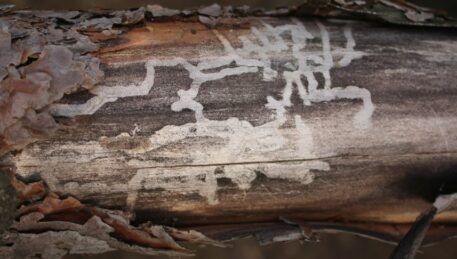
- Holes, boring dust, resin, galleries and blue stain under the bark.
- Wood on the plot: logs, tops, branches and stumps where beetles may breed.
- Causes of weakening: watering, soil, root zone and recent changes on the plot.
- Neighbouring plantings, a forest or reserve next door and the fallen wood in them: bark beetles fly from plot to plot.
What you receive
- A written consultative opinion: which pines are colonised, which are weakened and why, which can still be protected.
- Recommendations and a map of measures: what to do and when: when to remove colonised trees before new beetles fly out, what to do with the wood, whether other pines need preventive treatment.
- You do not have to look for someone to do the work: we remove colonised trees and carry out the treatments ourselves.
- A cost estimate is prepared on your request.
Every opinion, its decisions and recommendations pass a quality check that is separate from their development.
Frequently asked questions
Can a pine colonised by bark beetles be saved?
If beetles have colonised the trunk, the tree usually cannot be saved. No chemical treatment saves it, so the main measure is to remove it before the new generation flies out and to protect the other pines. If only the top or branches are colonised, examine without delay: the sharp-dentated bark beetle starts there.
Does bark beetle spraying help?
Preventive trunk spraying helps only before the beetles attack; after colonisation it does not save the tree. Whether to treat, and which pines, follows from the opinion after the examination.
When should pines be checked?
In spring and summer, when beetles are active, and at the first change you notice.
What should be done with the wood of a colonised pine?
Strip the bark or chip the wood to destroy the larvae in the phloem. Never stack fresh or colonised conifer wood next to living conifers.
The beetles come from a neighbouring plot or a neglected reserve. Is it worth doing anything on mine?
Yes. Beetles fly from plot to plot, so you cannot shut out a source next door, but they colonise weakened pines and fresh wood first. The examination shows what to do on your side of the boundary, and in what order.
What does bark beetle treatment cost for a forest of hundreds or thousands of pines?
The cost of the works is in the estimate after the opinion: it depends on how many trees and which measures the opinion sets. We name the cost of the examination on the call, when we agree it. For forest plots we carry out a forest pathology examination.
How are pines 30 metres tall treated?
We deliver the product through high-pressure hoses and apply it at the trunk and from above, so that it goes as deep as possible and does not drift in the air. Climbers go up tall pines. We choose the method for your plot after the examination.
Will climbers damage the bark?
No. The climbers go up on ropes, without spikes, so the bark is not damaged.
Can I send a photo?
Yes, a photo helps to agree the examination. The cause cannot be established from a photo or by phone.
Where do you work?
In Kyiv, the Kyiv region and across Ukraine. The examination is on the plot or remote.